
Talking Points with President Woodford: Faithful in the Means, Trusting the Spirit in the Results
A Pastoral Reflection on the Augsburg Confession, Article V
There is a quiet tension many congregations feel. On the one hand, we confess with confidence that the Holy Spirit “works faith, when and where it pleases God” (Augsburg Confession, Article V). On the other hand, we look around our sanctuaries, see the shrinking attendance, and wonder: Are we doing enough? Are we reaching anyone beyond ourselves? Should we be trying something different?
The Lutheran Confessions guide us in our kingdom work through both the dry and abundant seasons. However, sometimes our Confessions are used more as a prooftext to win an argument than a guide to understanding the Word of God and the mission of the church. We confess the Book of Concord to be a true exposition and correct exhibition of the Word of God, written to provide a clear understanding for the Church as she goes about her mission and ministry.
Augsburg Confession V (AC V) speaks directly to the above tension—not by resolving it in a simplistic way—but by grounding us firmly in Christ’s gifts and calling us to faithful action. It is a short and concise article on the nature and mission of the Holy Christian Church.
The Means Are Not Optional
The article begins with a striking claim: “So that we may obtain this faith, the ministry of teaching the Gospel and administering the Sacraments was instituted.” This is not a suggestion. It is God’s own provision clearly expressed in the scriptures (Matt. 28:18-20; John 20:23). Thus, if faith comes through the Word and Sacraments, then the Church’s central task is not innovation for its own sake, but fidelity to what God has given her to do.
The Word of God is efficacious: it is the sword of the Spirit, creating and sustaining faith. It is not mere data; it always does what it says.
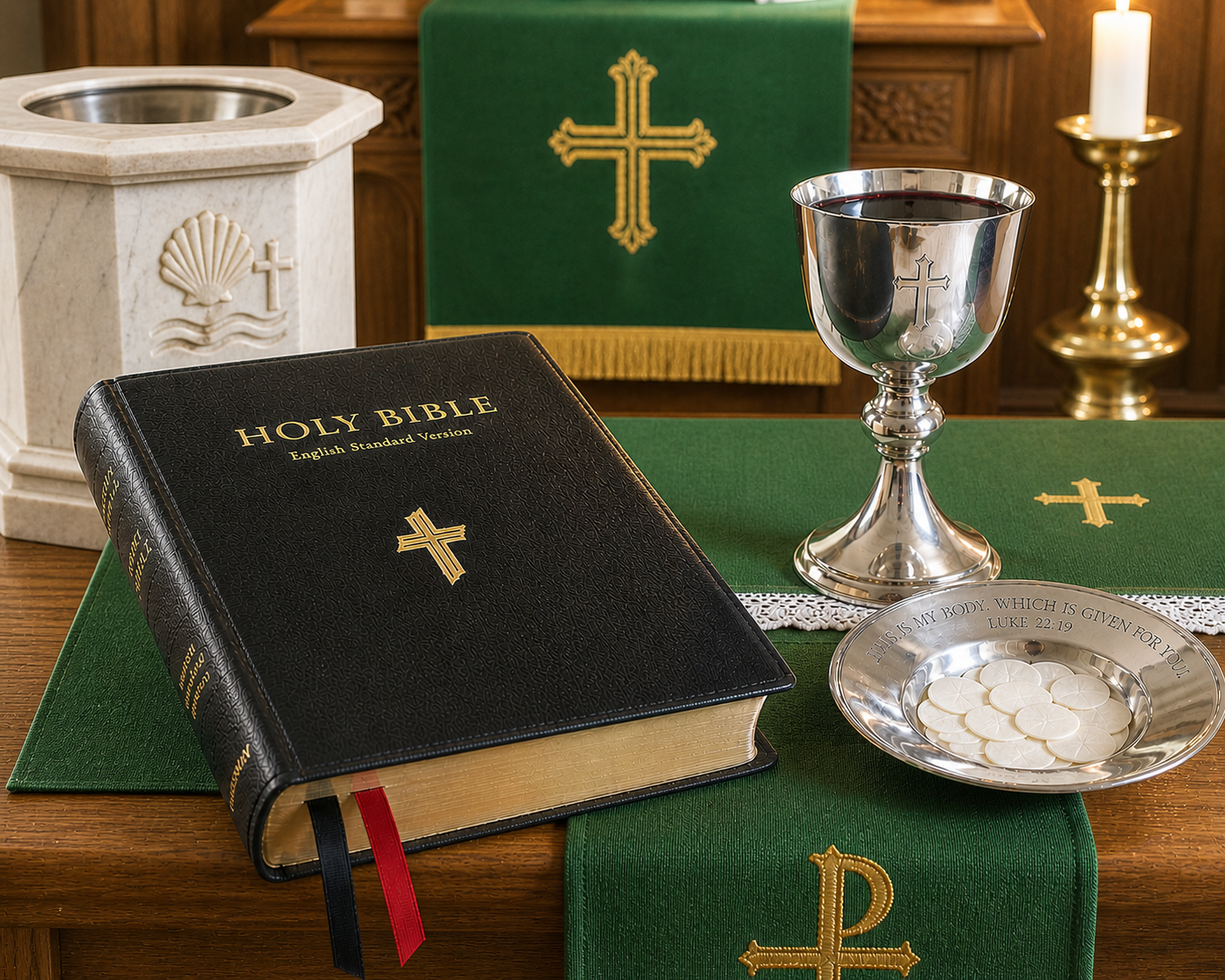
This means that every sermon, every Baptism, every celebration of the Lord’s Supper is not merely empty ritual—it is the very place where the Holy Spirit is at work. The Church does not manufacture faith by some assembly line production; it delivers Christ through His appointed means. And through this delivery the Spirit does what only He can do—creates faith.
This reality frees us from anxiety. Thanks be to God, the effectiveness of the Church does not rest on charisma, trends, or human ingenuity. Put plainly, faith is not produced by better marketing or more polished programming, (though such things are helpful in the organizational life of the church). Faith is given, specifically, through the Gospel—God’s chosen means of His Word—designed to deliver His gift of trust in Him for forgiveness, life, and salvation.
The Results Are Not Ours to Control
AC V continues: “Through the Word and Sacraments, as through instruments, the Holy Spirit is given [John 20:22]. He works faith, when and where it pleases God [John 3:8], in those who hear the good news that God justifies those who believe that they are received into grace for Christ’s sake.
This is both humbling and deeply comforting. It is humbling because it dismantles any illusion that we can control outcomes. No pastor can guarantee conversions. No congregation can engineer growth. The Spirit is not managed, scheduled, or optimized. As much as we may wish, human ingenuity cannot create faith no matter the depth of our desire or the zest of our zeal. Rather only two things are necessary, speaking of the Word and hearing of the Word.
This is also comforting because the burden of results does not rest on us. When the Word is preached and the Sacraments are administered, God is at work—even when we cannot see it. Seeds are planted in ways we may never trace. Faith may be kindled long after the moment of hearing. The Spirit moves in hidden and surprising ways.
This means that faithfulness is not measured by visible success. A small congregation faithfully proclaiming Christ is no less the Church than a large one. A pastor preaching to ten people is no less engaged in God’s work than one preaching to a thousand. (Though there will be obvious organizational implications as a church grows or shrinks.)
Faithfulness Does Not Mean Passivity
Yet this same article that frees us from anxiety does not excuse passivity. It is not permission for pastors to become complacent or hide behind the mere outward performance of the Divine Service as fulfillment of their duty. If anything, AC V intensifies our calling. If people are to hear the Word, we need to speak it to members and nonmembers alike. We must be sure we are, as Paul says, “doing the work of an evangelist” (2 Tim. 4:5).
In fact, precisely because God has promised to work through the Word and Sacraments, it matters deeply where and to whom those means are brought. Pastors are ministers (agents) of Christ and stewards of God’s mysteries (1 Corinthians 4:1). God the Holy Spirit works “in those who hear the good news.” That raises a simple but significant question: Who is hearing?
It is possible - too easy, in fact - for a congregation to become a closed circle of lifelong members, faithfully receiving the means of grace while unwittingly or perhaps even deliberately ignoring those outside its walls. But Christ Jesus did not institute the ministry for preservation alone – but for distribution: He intended that His Word be proclaimed for the joy and edifying of His holy people. In other words, the Gospel is not a possession to guard but a gift to deliver!
Intentional Outreach as Faithful Stewardship
Intentional outreach, then, is not a contradiction of our theology—it is an expression of it. If we believe that the Spirit works through the Word (Eph. 6:17), then we will seek to ensure that Word can be clearly heard and seen. Certainly in the Divine Service of worship, but also in our daily stations of life to family members, our neighbors and coworkers.
If we trust that the Sacraments are instruments of God’s Spirit to create and sustain faith, then we will desire that more members receive them, and we will take intentional and strategic steps to bring people into the hearing of the Word. Evangelization does not mean abandoning our confession for the sake of relevance. It means letting our confession shape our mission.
To be clear, strategic planning in our congregations is not about controlling outcomes; it is about stewarding opportunities. It asks questions like:
Where is the Gospel not being heard in our community?
What barriers—cultural, social, or practical—keep people from encountering Christ’s gifts?
How can we bring the Word and Sacraments to those who are not yet part of our life together?
Such planning is not a lack of trust in the Spirit. It is trust that God works through these sacred means. We desire to see those means implemented as widely as possible.
Holding Both Truths Together
Therefore, the Church lives in a kind of holy balance:
We are faithful without predicting or controlling results because the Spirit alone gives faith.
We are active and intentional in outreach because the Spirit works through the means we are charged to steward.
If we lose the first, we become anxious, measuring ourselves by numbers and outcomes.
If we lose the second, we become inwardly focused, content with what we have received but reluctant to share it. Augsburg Confession Article V calls us to uphold both.
A Quiet Confidence
In the end, our confidence rests not in our plans or our performance, but in Christ’s promise. The same Lord who instituted the ministry has also given His Spirit. The same Spirit who works when and where He pleases has chosen to work through the Word and Sacraments. So we preach. We baptize. We commune. We teach. We invite. We evangelize. We plan. We go.
Not because we can guarantee results—but because God has promised to be at work through these very things. And that is enough.